Wednesday, 8 June 2022

A summit of equals

 Anyone who has been keeping up to date lately with recent events would no doubt be familiar with the current kerfuffle regarding the upcoming Summit of the Americas that is set to take place in the United States. This summit is normally the highest diplomatic level meeting of all members of the Organisation of America States (OAS), an intergovernmental organisation (IGO)  comprising of all sovereign  countries located in the western hemisphere i.e. North America, South America, Central America and the Caribbean. International law as stated in the Montevideo Convention on the Rights and Duties of States declares that all independent countries are to be seen as equally sovereign and treated as such by the international community.  A fact that is clearly lost on the United States who have taken it upon themselves to unilaterally exclude the duly elected presidents of Cuba, Nicaragua and Venezuela over purely political reasons. This as anyone can see is a gross dereliction of decorum as the US has decided to in a most undemocratic fashion make unilateral decisions without consulting the wider membership of the OAS.


For their part, many countries in the region such as Mexico and even St Vincent have responded with rage and shock at this decision. And while the outrage might be justified, the shock should be less so, not if anyone knows the history of USA’s relationship with the rest of the continent. Going as far back as its very foundation in 1776, the then scattered colonies upon declaring independence from Great Britain decided that they were going to take the name of the entire continent for themselves as if to say they were the only “America” when in truth that had previously been the name given to the whole hemisphere. It shouldn’t be surprising that this is their attitude given their doctrine of Manifest Destiny to conquer and annex other lands eventually. Decades later, following the Latin American colonies declaring their own independence from the Iberian kingdoms, the US wasted no time trying to assert its hegemonic dominance over the continent when President James Munroe in his 1823 State of the Union Address declared the Munroe Doctrine in which the US all but declared the rest of the continent as pseudo-tributary states. Since that time, the Doctrine has been the cornerstone of US policy towards its neighbours. Several successive Presidents and Secretaries of State have since cited the Doctrine as justification for violating the rights of its sovereign neighbours. It should be noted that the Munroe Doctrine has absolutely no legitimate standing in international law. This has not stopped Uncle Sam from using it as an excuse to trample on the dignity of its closest neighbours some examples include the Roosevelt Corollary and the Platt Amendment not to mention the numerous invasions in places like Panama, Nicaragua and Grenada while also sponsoring coups in Chile and Paraguay. But most egregious of all has been their despicable treatment of Cuba, included in this, is their sponsoring of the Batista regime and their failed Bay of Pigs invasion. Nothing however could possibly be worse than the embargo they have had in place since 1962. The US can talk all they like about how they refuse to trade with Cuba because of its form of government but that talk is all smoke and mirrors as they have no issue doing business with China which is also run by a communist party. Everyone knows that the US is fond of maintaining Cold War relics (such as NATO) in its orbit and the Cuban embargo is but another one of these. Both the United Nations and the OAS has repeatedly condemned the US for continuing to stifle Cuba but their please have mostly fallen on deaf ears. The US has long made the claim that the original purpose of the embargo was to prevent the Soviet Union from gaining a foothold in the region but the Soviet Union is long dead and its Russian successor certainly isn’t looking to expand into Cuba. Although the opposite isn’t true as the US has been for the last 30 years been using NATO to move closer to Russia, which Ukraine is now paying the price for as we speak. But this is not a discourse on the East but rather on the West.


The US has on many occasion acted in bad faith in dealing with the rest of the Americas, in 1996, Congress passed the Helms-Burton Act which imposed harsh penalties for any third country that chooses to trade with Cuba. This was but another example of US arrogance, taking it upon themselves to restrict the sovereign right of nations in the Americas to trade with whoever they wish. This exercise of extraterritorial jurisdiction like the Munroe Doctrine has no legal standing and independent states should not have to bow to will of another country since we are all equal before the law.

Speaking of law, the same Helms-Burton Act has also sought to define the form of government that Cuba should have, something they have since repeated with Venezuela when they decided to handpick their own candidate by the name of Juan Guido as president. It should be noted that Guido was never voted for by the Venezuelan people, but was merely a Venezuelan politician who the US felt would be more malleable. And while some might make the argument that Nicolas Maduro wasn’t legitimately elected either, the fact is, it is not the place of any outside power to decide who the head of state should be. Even if the country is not a full democracy (which I’m not saying about Venezuela), the US has no business trying to force Cuba or Venezuela to be more “democratic”. Am I saying that these two countries should be classified as democracies or that I am full support of everything their governments do? Not at all, what I am saying is that whether these countries move to democratise or not; it should be up to them to decide. Having the US Impose its will from top-down will not make them more democratic. Democracy, by definition means a government ruled by the will of the people; obviously this means that a country that has its destiny decided by another is not a full democracy (unless the people there voluntarily choose to remain under this sovereign power by a plebiscite).


By intervening in the internal affairs of Cuba or Venezuela, the US demonstrates its own hypocrisy. In their 2016 presidential election cycle, the US made certain accusations against archrival Russia, who they claimed interfered in the election process to ensure an outcome favourable to them. This then demonstrates that they clearly know that interfering in another country’s domestic politics is wrong. Why then do they think, they can handpick who is to be President of Venezuela?, what gives them the right to have a say in what Cuba’s form of government should be? And how is it that a single country gets to decide how an IGO should be run? What is even more interesting is that you only see this kind of hegemonic one-upmanship in organisations that have the US as a member such as the OAS and NATO, whereas this is noticeably absent in bodies such as the Commonwealth or CARICOM from which the US is excluded, it is clear what the common denominator is here. The US constantly likes to berate other countries for their human rights record, using it as justification to impose its will on other countries but as we are all aware by now, the colossus of the North has its own human rights issues to deal with as demonstrated by the amount of mass shootings that constantly takes place there, a feature which doesn’t commonly happen in any other country, regardless of how democratic or autocratic they are.


What’s my point in stating all of this? America sees itself as the exceptional nation, this is what they use as the ethos to justify actions that they themselves would never allow any other country to get away with. But if the reaction of the rest of continent is anything to go by, it is not clear that no one else is willing to buy into the myth of American exceptionalism, nor should they. It would be a gross insult to the dignity of all other nations to let the US alone (as oppose to majority of the OAS) dictate the terms of engagement. Leaders such as Prime Minister Gonsalves of St Vincent and President Obrador of Mexico should be supported by the rest of the grouping in standing up to the bullying tactics of the US. The world is fast moving away from its post-cold war unipolarity and is fast becoming multipolar, with blocs such BRICS and the EU taking a more prominent role on the world stage. The US is rather slow to recognise the changing world order. Yes, it is true that the US is still for now the world’s premier superpower, but how history tells us that declining superpowers don’t fall in a day, (just ask the Russians or the Brits). Not that I am predicting the fall of the US anytime soon but what I am saying is that it cannot expect to hold on to its unilateral superiority indefinitely, sooner or later, it will have to share the top spot with a rival. The sooner they grasp this concept, the better they will be able to treat other countries like equals. This should not be something hard for them to fathom. Their own Declaration of Independence states that all men were created equal; in that same vein they should also recognise that all nations were created equal. This is the fundamental principle that governs international relations and it is this core tenet that the OAS is supposed to represent, in other words you can say that the Summit of the Americas is meant to be a summit of equals

Wednesday, 20 April 2022

Smith vs. Scotland: My Thoughts.


A few weeks ago, the government of Jamaica announced that it was putting forward Foreign Minister Kamina Johnson-Smith as a candidate to succeed Baroness Patricia Scotland as Secretary-General at the Commonwealth Heads of Government Meeting (CHOGM) in Rwanda later this year. At first, it seems like a rather standard procedure given that the position is apparently up for election at the next summit. But a few subsequent developments have caused me to wonder if there was more to this than meets the eye.  Normally, the position is only really contested when the incumbent Secretary-General has announced their intention to step down from the position, which would require the election of someone new (as was the case in 2016). This is certainly not the case here as the Baroness has already indicated her interest in serving a second term. It must be noted that there is nothing in the Commonwealth Secretariat’s rules that prevents the Secretary-General from being challenged mid-term but it is simply a matter of convention, not to. But it is not this alone that makes this case interesting but also the narrative surrounding it. For one, the decision to nominate Johnson-Smith has already proven to be controversial, with the Antiguan government accusing Jamaica of trying to divide both CARICOM and the Commonwealth with this move. I note with interest that it was Antigua and not Dominica that came out with this strong condemnation. The reason for this is that Lady Scotland is a dual citizen of the United Kingdom and Dominica. Furthermore, the government of Dominica was instrumental in getting many other Commonwealth countries to support her candidacy back in 2016. Antigua and Barbuda on the other hand was not among those who supported this move as their intention was to place their own Sir Ronald Sanders in the position but they were ultimately unsuccessful in this bid. I wonder if their lashing out at the Holness government now has anything to do with the fact they did not get their way last time around and as such would not take kindly to any attempt by Jamaica to succeed where they failed?. Conjecture?, Maybe, but who knows, we will just have to wait and see.


I also note that in the space of a month, Jamaica has received back-to-back state visits, both of which can be connected with the current political row. Ostensibly, both of these visits were connected with the Jamaica 60 celebrations but I would not be surprised if the matter of the minister’s candidacy also came up. As explained earlier, the next CHOGM summit is expected to take place in Rwanda later this year. And only last week, Jamaica played hosts to His Excellency Paul Kagame who as President of Rwanda will also serve as the next Commonwealth Chairman. Is it just coincidental that of all the African leaders to invite, the government choose Kagame?, Not that anything is wrong with that choice, Kagame’s record in transforming Rwanda speaks for itself and were I in the Prime Minister’s position I might have done the same. But from I know about diplomacy, altruism can also take one so far and I would not be surprised, if the visit by Rwanda’s president had anything to do with ensuring that the CHOGM summit would be chaired by someone that would side with our government, it’s rather shrewd.


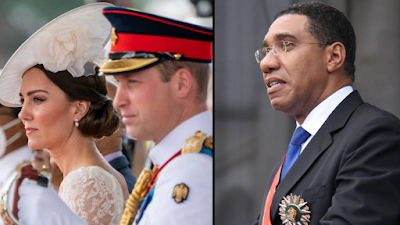
But if that is the case, we’re not the only one engaging in smart diplomacy here. In a report published by the UK’s Daily Telegraph, it seems that the Boris Johnson government is not very happy with Scotland’s performance and is seeking to have her replaced. It should be noted that PM Johnson is himself the current Commonwealth Chairman and as such has raised serious concerns about the Baroness’ leadership style and also corruption allegations during her tenure. The Telegraph further alleges that when His Royal Highness the Duke of Cambridge visited Jamaica, he not only came to give us the Queen’s salutations on our 60th anniversary but also had another mandate from Johnson in which he was to open talks with our government about putting forward a candidate to replace Scotland after the Kenyan government withdrew the candidacy of their own Monica Juma.  The Johnson government in Britain seems determined to get rid of Scotland and has even called upon the royal family to aid them in this task. This assertion made by the Telegraph is at first seemingly far-fetched given that convention dictates that the Crown remains above politics. But yet, there might be some truth to this for several reasons.


 First of all, anyone who knows anything about how the Commonwealth works is fully aware how central the monarchy is to its continuation. Going as far back as the first imperial conference of 1887, the royals have been promoting the idea of common kinship ties that binds all the peoples under the rule of the then British Empire. As the 19th century rolled into the 20th and the empire was dissolved to make way for a Commonwealth of (equal) Nations, the centrality of the monarchy remained, even as it became clear that British hegemony must end in favour of a more egalitarian ethos. Some might wish promote the idea of a future Commonwealth being more republican, headed by someone not of royal blood, but I wouldn’t hold my breath for this. As recently as the 2018 CHOGM summit, all Commonwealth states (regardless of their domestic form of government) assented that for the foreseeable future, the Queen’s heirs and successors would continue to be Heads of the Commonwealth, this follows on the heels of the Perth Agreement which was signed at the 2011 CHOGM summit, which changed the succession rules to a more gender neutral bent. It’s rather hard to fathom that these countries would now want to make the Commonwealth headship into a pseudo-presidency and as such the logical conclusion one must come to, is that title will continue to have the same monarchical connotations it always has. This makes it highly likely that the Duke himself will one day hold the place that his grandmother does now in the Commonwealth, who better to use as go-between between the Jamaican and British governments?


The second reason, why, this Telegraph’s story might have some credibility is the timing of the announcement. I for one, note that the government’s decision was announced a mere two days after the Cambridge departure, was this time coincidental or was it calculated? It could be deemed as the former, were it not for the fact that Minister Johnson-Smith was the very first government official to greet the royal couple on their arrival at their airport, which is rather different from the standard practice of having either the prime minister or the governor general getting this honour. I can’t help but wonder if in these lengthy chats that Prince William had with either the prime minister or the foreign minister, the matter of the upcoming CHOGM summit was ever discussed (as the telegraph asserts). I also equally wonder if during President Kagame’s visit, the matter was also raised?


Again, all of this mere speculation, which can either be proven or disproven when CHOGM is finally concluded. One thing I do take issue with, is the assertion that Jamaica is merely used as a pawn in all this.  I wholeheartedly disagree; as I am of the view that if there is any truth to any of this, that Jamaica would be a player not a pawn in this game of diplomatic chess. It is clear that the government’s ambitions are high and if it sees any opportunity to flex its diplomatic muscle, I say more power to them. I see no reason, why the government should yield to Antigua’s position, given that one can argue that it comes from a standpoint of rank hypocrisy. Nor should they follow Kenya’s example in withdrawing a candidate that was clearly qualified for the post. Instead they chart their own path and if that path means going with an alternate candidate so be it. If it is that other powers e.g. the UK are seemingly in support of removing Scotland like we are, it does not make us pawns in their game but rather it makes us equals, allying together to achieve our mutual interest. Altruism is all fine and dandy, but the same Antigua that now preaches said altruism, was itself not following its own message only a few years ago, yet now they expect us to do so? I think not. I say keep Johnson-Smith in the race, if Scotland’s record stands up to scrutiny, there shouldn’t be a problem. But if it doesn’t why shouldn’t there be an alternative waiting in the wings? This is how international relations work, this is how organisations thrive and in this having someone in the top post with an impeccable record will only help to make the body into a stronger commonwealth.


Thursday, 27 January 2022

Another world war in the offing?


Anyone who has the following what has been happening in the Eastern Europe, in the Middle East or in the South Pacific lately would of course find the sabre rattling tendencies rather worrying. Nevertheless, I cannot help but ask the question, is there a global conflict on the horizon? It seems insane right, why would anyone even think of such a thing, two world wars were already two more than anyone wanted, Yet as insane as it might be to speculate on, the world now doesn’t look so different from it how it did prior to the world wars. In fact anyone who studied that period of history will find some eerie similarities.


The first such comparison that will be drawn is the military buildup. Prior to the outbreak of the First World War, Britain and Germany were engaged in a fierce arms race with both sides constantly upgrading their arsenal to the latest technology available at the time. This culminated in the construction of the Dreadnought class battleship by the Royal Navy, which was later copied by its rivals with designs of their own. Similarly today, great powers constantly try to outdo each other to see who has the latest and most potent weapons and are certainly not afraid to show them off. This in and of itself should be worrying enough, but the parties in the arms race didn’t always operate in isolation but rather cooperated in strategic alliances to deter rivals. Is it any different now? Who can forget late last year, when the US, UK and Australia announce the formation of the tripartite pact known as AUKUS?  The whole idea behind this is that it should serve as a deterrent to Chinese ambitions in the South Pacific. This looks oddly similar to the Entente Cordiale that was signed shortly before the First World War to deter German ambition. The Chinese of course didn’t take very kindly to this and respond by calling the three states paranoid. Yet the actions of the PLA (Chinese military) might actually provide justification for such a show of force by AUKUS. China has been known to aggressively increase their naval presence in the South China Sea as of late while their Air Force has been conducting military drills in Taiwanese air space. The PLA has also been seen testing hypersonic missiles which circles the world in orbit, pointing to its deadly accuracy. 


The Western powers are not the only ones wary of China. Japan since World War Two has taken an official position of pacifism but given their geographical closeness to China their current stance is anything but. Japan’s Self Defence force has developed to an advanced stage with air and naval capabilities surpassing anything they have had since WW2. But what is worrying most of all, is the influence of Nippon Kaigi among the Japanese ruling elite which openly calls for Japan to remove article 9 and drop all pretence of pacifism, this would then make them an Asian military powerhouse once again, making the situation in East Asia more tenuous than it already is. Not to be left out, India has also has their own contingency plans for dealing with China as they have recently purchased a series of S-400 missile defence systems from Russia and set them in strategic points that pundits claim are meant to fend off any Chinese attempts at an incursion. 


And speaking of Russia, they are at present an even bigger problem for Western powers than China due to their actions in Ukraine. At present, the whole Eastern front of Europe is on a mere tipping point, with ever growing speculation as to whether or not Russia will invade Ukraine. This is something that the US and it’s allies in NATO are rather wary of as both sides are locked in a standoff. The best hope anyone can have is that all sides can reach a rapprochement before it gets to the point of no return. According to the Russians, NATO expanding into Ukraine would violate an agreement with the Soviet Union that NATO would never expand eastward after the fall of the Iron Curtain. NATO on the other hand contends that no such deal was ever made and that Ukraine is a sovereign state, free to join whatever alliance it likes. This sore point is what leads to the security dilemma we have today as neither side is willing to relent, both feeling threatened by the other. Russia for its part has responded with a massive military buildup on the Ukrainian border. NATO however is not standing idly by as Britain and several other member states are already sending arms to Ukraine while France is openly touting the possibility of a European Army to defend the continent. 


The ambitions of the EU and NATO have hit a major hurdle as unlike Russia, the West is comprised of different countries with competing interests. Whereas French President Emmanuel Macron is all for a common defence force for the continent, new German Chancellor Olaf Scholz is of a much different mindset, unlike most of NATO, Germany is not inclined to go to war with Russia as they would have too much to lose if it ever did come to that given that they are one of the biggest recipients of Russian oil and natural gas, which means any stop to that supply would lead to major downturn in Germany’s lead as Europe’s major manufacturing giant. This case scenario, one must admit, would make it different from the two world wars as this time Germany would prefer the role of peacemaker rather than aggressor.


This then lead to the discussion regarding the economic comparisons between the war period and now. It is hardly a secret that following the end of the first war, the world fell into a great depression which was only ended when the second war came about.  The question of whether or not war is good or bad for the economy depends greatly on who is asking. The world economy as we know it now is a disaster, due primarily to the COVID-19 pandemic which has caused a downturn in many major economies with economists predicting that the current depression will hit the levels seen the Great Depression.  History tells us that in the US, while the federal government tried to restart the economy through the “New Deal”, what really got the economy moving again was the manufacturing capacity being expanded in the war and post-war period. The US as it stands now is in a bad place economically and unlike FDR’s “New Deal”, Biden’s “Build Back Better” programme to restart the economy has indefinitely stalled in Congress. It would not be completely far-fetched to state that nobody really wants war ...unless you were part of the Military-Industrial Complex, which some still think is mere conspiracy. Yet, Democratic congresswoman and former Presidential candidate Tulsi Gabbard has stated point blank that this is exactly what is happening and has referred to some of her colleagues as warmongers for pushing the narrative regarding Russian aggression. The prospect of war profiteering is horrendous to think about and yet with everything going on there are clearly rumblings of a shift in economic and also political power on the global scale, which some say is but one stage in bringing about the new world order


The pandemic of the last two years, has paved the way for some changes in the system, yet the question still remains as to whether or not the world is unipolar or multipolar and where does the power really lie. The idealist in me tends to think that such a question can be settled peacefully but the realist in me would not dare be so naïve, after all as German Chancellor Bismarck once said “It is not through speeches and debates that the questions of the day will be decided but through Iron and Blood”.  The talk of a peaceful rise of China or resurgent Russia is all nice but as history tells us, it is only through war that the global order has been so drastically reset. The Napoleonic wars led to the rise of the concert of Europe and the congress system, the First World War led to fall of several century old empires and the redrawing of the maps of Europe and the Arab world, while World War Two cemented the dominance of US and the USSR, gave us the UN and Brettonwoods systems and most importantly led to decolonization which also redrew the world map. In all the halls of power, there is talk of a Great Reset, one that they say is influenced by COVID-19, but is it farfetched to surmise that this alone is not enough to justify such a reordering of the world system? Look back at World War Two, the economy was changed as much as the politics, yet the Brettonwoods economic system did not rise from anything in the war but from the depression that preceded it, a great reset that looks at changes in the entire geopolitical structure might take a similar approach.


Much of this sounds hyperbolic and I for one am hoping to be dead wrong on this, yet I cannot help but look at the similarities and wonder. At the start of 2022, the UN Security Council (including the P5) promised there would be no nuclear war yet within weeks of this, countries already started making aggressive moves that tips the world closer to the brink. China has continued its aggressive moves in the South Pacific, while Russia does the same at its border with Ukraine border even while France and Britain continue to openly arm Kiev’s government and the US stands in the middle of it all threatening sanctions but doing little else. This resembles what happened in the interwar period when the great powers signed the Briand-Kellog pact to limit armaments only for them to all turn around and violate said agreement. Nor is this aggression limited to P5 nations, North Korea has continued to test their own hypersonic missiles, ignoring UN sanctions,  Iran also continues to pursue it’s own nuclear agenda refusing to renegotiate the nuclear deal meanwhile Saudi Arabia continues to act as foil for Iran in their rivalry for regional domination.

With all this said, the question remains, is the world really heading for another war or is this sabre rattling, just that and nothing more?, US President Teddy Roosevelt once described deterrence as to “Speak softly and carry a big stick”, the problem is, this saying works best in a unipolar world when only one party has said big stick, in this case however, we are seeing the makings of multipolar or even nonpolar world, even that is unsettled and I’m cautiously looking at the world’s geopolitics as it is, wondering if another war is the means they will finally use to settle it.


Friday, 31 March 2017

Europe's Grand Opportunity

So article 50 has finally been triggered , what it will mean for the future of Britain, Europe and regional integration at large?. It never really occurred to me until now that the Europhiles are in truth wasting a grand opportunity and I’ll tell you why. After seeing the arguments for and against BREXIT, I have held that Britain leaving the European Union might just be the best thing for Britain however of late I have also been thinking that Britain leaving the EU actually is actually what is best for the rest of Europe as well. I know, I sound absolutely crazy to even think of such a thing but hear me out, and then take a good look at the evidence to decide for yourself.

Image result for european union

 The European Integration process didn’t occur overnight, instead it was decades in the making and started all the way back to the European Coal and Steel Commission with 6 states in 1951, over the years this has grown and evolved to the European Economic Community and later to the European Union we know today, the question is where does Britain fall in all this?. For all the strides it has made, European integration is not yet completed, it started out based on functional cooperation but then evolved into a regime and later still started operated on a neo-functional principle. According to political scientist Ernst B. Haas in his 1958 work The uniting of Europe: political, social, and economic forces. The rise of functional cooperation between states will lead to cooperation in other areas thus deepening integration between countries in a particular region, this he called the “spill over effect”, according to him, for any union of states to truly work then states must be willing to partially surrender their sovereignty to a pooled body in order to serve the greater good of the region. This is currently where the EU is at today, as the evolution from a single commission to a supranational entity makes it the most advanced experiment in regional integration to date.


Image result for european union
That being said, the EU isn’t satisfied with being governed by functional or neo-functional ideal but wishes to move one step further into full blown federalism, already the wheels of this have been set in motion with the European Parliament, the EU Commission, the European Council, the ECJ and a plethora of accompanying institutions, they now have a common currency, central bank and trade policy but the dream of a federal Europe is not complete as yet, there more left to be done in order for the Europhiles to achieve their ultimate ambition which is a United States of Europe.
Ironically enough, the term United States of Europe was first coined by revered British Prime Minister Sir Winston Churchill who was a firm supporter of the idea of a United Europe, as he believed that this would be the best way to avert war on the continent when he made the quote “It is to re-create the European Family, or as much of it as we can, and provide it with a structure under which it can dwell in peace, in safety and in freedom We must build a kind of United States of Europe.”  Those who would use this quote to justify why Britain should remain in the EU however are those who focus on this line while failing to  recall the rest of the 1946 speech which also had the following to say “In all this urgent work, France and Germany must take the lead together. Great Britain, the British Commonwealth of Nations, mighty America, and I trust Soviet Russia - for then indeed all would be well - must be the friends and sponsors of the new Europe and must champion its right to live and shine.” This then goes to show a clear evidence that while Churchill did advocate for a USE, even back then he knew that if it was going to succeed then it must needs exclude Britain as it is clear that Britain’s future lies elsewhere.


Image result for united states of europe

And was he wrong to assume this? Not at all, history has shown that every attempt to bring Europe together whether by coercion, sheer force of will or voluntary democratic means has always been foiled by Great Britain,  stretching as far back as the Treaty of Westphalia in 1648 whereas the rest of European potentates were one by one signing on to this ground-breaking document pledging non aggression and respect each other’s sovereignty, neither England, Scotland nor Ireland (then 3 separate kingdoms under a single monarch) were present even while their continental neighbours were. Later on at the rise of the Holy Alliance, while the great powers of Austria, Russia and Prussia were steadily increasing their cooperation to signify the rise of a new order in Europe due to fall of both the Holy Roman Empire and Napoleon’s continental system, Britain stood outside of the fray and steadily refused to join any such agreement even while the rest of Europe were declaring their acquiescence to its principles.  And while it is true that Britain did cooperate in the 1815 congress of Vienna that created the concert of Europe it did not gain as much as the great powers on the continent itself because its interest lied closer with its imperial holdings elsewhere than with Europe itself. Eventually as the European Coal and Steel Commission was being upgraded to the European Economic Community, while many other states joined with little internal fuss, it was not the same with Britain which spent a long time debating whether or not they should even sign on in the first place and even afterward, the mood in the UK itself was still one of half-heartedness where the UK was never truly committed to a united Europe like say a France or Germany.
  Image result for pound vs euro

Nothing more explicitly showed this fact than in 2002 when the European Union decided to unveil its new currency the Euro. While one by one, European countries abandoned their national currency to join the Eurozone, the United Kingdom steadfastly refused to let go of its pound sterling. It must be noted that Britain isn’t the only EU outside of the Eurozone but it is the only country qualified to join to Eurozone (pre BREXIT) that has not done so, the other non-Eurozone countries are kept out of the Eurozone because they do not meet the economic convergence criteria set by the European Central Bank, Britain however CHOOSE to keep its monetary sovereignty, thus again showing their traditional lack of commitment to fully immersing itself in the EU.


Another thing that depicts Britain’s unwillingness to join a United States of Europe is the way they view themselves in the world, In addition to Europe, Britain’s foreign policy has always heavily featured its Atlantic Connection and its relationship with the Commonwealth. Britain wasn’t the only European power to build a colonial empire, France, Spain, the Netherlands, Portugal and even the Belgians did exactly the same thing. But none of these former colonial rulers kept the link with former vassals like Britain did, sure the French has la Francophonie while Spain and Portugal tried the Latin Union but neither of them reached the same level of influence of the Anglosphere and even while Britain had one foot in the European Union, the Commonwealth continued to grow and thrive. Its special relationship with the United States is nothing to be taken lightly either, beginning with F.D. Roosevelt and Sir Winston Churchill, relations on both sides of the Atlantic have been for the mostly excellent, with a few ups and downs of course but the United States isn’t likely to forget that Great Britain alone supported their decision to go into Iraq while the rest of Europe decried it as criminal (whether these allegations have any merit isn't the  point here, this is not a discourse in international, law), the point is that the notion of CANZUK and its connection with the rest of the Anglosphere remains strong. And while some overeager enthusiasts have been banding the notion of Empire 2.0 about, I wouldn’t hold my breath for it happening anytime soon, but the very fact that this notion does exist is testament to the fact of how Britain views themselves as being separate from Europe.

 Image result for united states of europe churchill


What exactly is the point I’m trying to make by all of this? It is quite simple, for the proposed United States of Europe to be transferred from idea to reality, it must (I repeat must) exclude Great Britain, centuries of precedent have shown time and time again that every attempt to unite the states of Europe under a single flag (whether by force as Napoleon tried or by choice as the EU is doing now) has always been thwarted by the Brits and its interest. It is clear time and time again, that Britain’s interest lay outside the continent, anybody ever wondered why prior to World War I, while the UK had the world’s largest navy and biggest empire, Germany and Austria-Hungary  still had more influence in Europe than they did?  Its not because they couldn’t project power in Europe, its simply because they didn’t want to. France and Germany should take Churchill’s advice, forget about trying to bring Britain into the fold and use their influence to work to integrate the rest of Europe even further. Europhiles shouldn’t weep over BREXIT, rather they should rejoice as now a great obstacle to European statehood has finally been removed as it would have never worked with Britain in the mix, not in the sense that the federalist dreamed of. If the federalist really want to seize their grand opportunity then now is not the time for Europe to be talking about losses but instead use this as the perfect opportunity capitalise and take the dream of a United Europe forward into the future.


Sunday, 19 February 2017

Don't Blame the Reformation


A conversation I had the other day makes me always wondered why it is some Catholic royalists blame Protestants for the rise of republicanism, even an article in The Economist not long ago seems to agree. Irrespective of the infamous Game of Thrones quote which claims that "The faith and the crown are the two pillars that hold up this world. One collapses, so does the other," which I must admit is true to an extent but when I examine the facts I’m forced to question some elements of this assumption made by some of my fellow traditionalists and I’ll explain why?

 1. The principle of the “divine right of kings” which Catholics claim to have a monopoly on states that Kings are answerable to God alone, yet the Papacy has deemed that all kings of the earth must answer to them and claimed the right to set up and depose kings, although Daniel 2:21 clearly points out that only God himself has the exclusive right, a right that the Bishop clearly tried to usurp for himself, one example being when Pope Pope Gregory VII composed the Dictus Papae asserting the authority to overthrow whichever King he chose (in this case Henry IV of Germany). It was in fact the Protestant reformation that promoted true essence the divine right since it removed the imposition of the papacy as an intermediary and made rulers answerable only to the Grace of Heaven, not the will of Rome.

Image result for crowned by god


2. The writings of the protestant reformers shown in no uncertain terms that they were most certainly not republican in orientation. For example Martin Luther in his 1525 book “Against the Murderous, Thieving Hordes of Peasants”, stated and I quote “anyone who is killed fighting on the side of the rulers may be a true martyr in the eyes of God…. if anyone thinks this too harsh, let him remember that rebellion is intolerable and that the destruction of the world is to be expected every hour”, he also the urged the rulers of the time to crush the revolutionaries like mad dogs and that civil powers must drive the common people, that they may learn to fear the powers that be.- does that sound like a republican or revolutionary to you?, note this is the poster man of the reformation speaking here

3. Some of the greatest moments in the history of the reformation happened with the blessing and sanction of monarchs, e.g. the Authorised Bible Version of 1611 was published with the  vehement opposition of the Catholic Church yet happened under the sanction of James VI; There was also the Act of Supremacy (1534) which made the monarchy, not the papacy, head of the Church of England. Similarly in other protestant kingdoms their rulers were given similar status, something that could not happen for Catholic monarchs who (according to the papacy) were vassals of the Pope 

Image result for diet of worms

4. In relation to point number 1, the main driving vehicle of the counterreformation was the Jesuit order established in order to put an end to the reformation,  the oath taken by the Jesuit order includes the phrase  “I do now renounce and disown any allegiance as due to any heretical king or prince named Protestants, or obedience to any of the laws, magistrates or officers thereof”…traditional monarchist? I hardly think so, in fact this is a downright rebellion against the concept of monarchy (that does that pledge allegiance to the pope).

3. The Jesuits are not the only ones guilty of this either for example Cardinal Robert Bellarmine claimed that the institute of monarchy did not have any divine sanction (clearly contradicting 2 Peter 2:17) and even declared it lawful for Catholic subjects to overthrow a monarch they didn’t approve of (Such as Jacobites in the British Isles constantly whining about the legitimacy of the House of Windsor and calling for its overthrow) similarly Father Juan de Mariana a noted Catholic Scholar and clergyman promoted the idea of social contract (made famous by John Locke) and even advocated for regicide (which they dubbed as tyrannicide) which he claimed justified the murder of protestant kings in the name of the Catholic Church.

Image result for king vs pope
.       
6. The reformation strengthened the institution of absolute monarchy not weaken it, Martin Luther in his “To the Christian Nobility of the German Nation”  decried the institutions of feudalism and called for a more centralized monarchy where persons will not have a divided allegiance to the Pope, their King and their local lord but rather just as how no pope should stand between the people and their allegiance to their heavenly sovereign, in the same way the people’s earthly loyalty should be directly to their king not indirectly via manorial lords. This idea laid the foundation for strong centralized monarchies taking the place of weaker feudal kingdoms,  is it any wonder that the golden age of absolute monarchy happened in the wake of reformation?; something both Catholic and Protestant monarchies benefited from. 

    7.  Noted Christian Author Ellen White in her book “The Great Controversy” when speaking of the factors that led to the French Revolution saw it as a divine judgement against France for its rejection of the reformation movement whereas countries like Great Britain and the Scandinavian countries which accepted the reformation were spared from the horrors of republicanism. Not that the attempted reformation by the Huguenots was republican or monarchists in character, in fact there were members of the French royal family on both sides of the divide. What she did assert however is that because the French had refused to accept the reformation teachings and so brutally persecuted the reformers even more than other European powers (case in point being the St. Bartholomew’s Day Massacre of 1572), then God left them to their fate when the revolution finally broke out and utterly destroyed the power of both the catholic church and the monarchy in France. Naturally,a great many Catholics would take offence to this idea and the nature of the claim itself can be argue all day long  but  as far the writer was concerned, had the French reformation taken been a success,  there would have been no French revolution.

Image result for divine right of kings

8.The final evidence that goes against the idea of blaming Protestantism for republicanism is the numbers. For example in Latin America, the region of the world that has the largest population of Roman Catholics per capita in the world does not have a single monarchy among its ranks. Similarly in Europe today the number of Catholic and Protestant hereditary monarchies are evenly match at 5 to 5, with Britain, Netherlands, and the three Scandinavian Countries representing Protestantism while Monaco, Luxembourg, Liechtenstein, Spain and Belgium are the only remaining Catholic monarchies in Europe. Outside of Europe there remains only one native protestant monarchy (Tonga) and one Catholic monarchy (Lesotho), so again the question is to be asked, what happened to all these other Catholic majority countries where the reformation never took root?, how comes they didn’t retain or restore their monarchies given that Protestantism was “the main culprit” behind it all? And while on the topic of abolition, Let's not forget how Irish Catholics played a key role in supporting the IRA in their overthrow of the British Crown and the breaking up of the union; If Catholicism automatically made one a loyal monarchist, the Catholic dominated IRA clearly never got that memo. 


Is this in any way an attempt to link monarchism or republicanism with a religion?, not at all, the religious reviews of monarchist and anti-monarchist are as diverse as their views on political matters, I know of  Catholics aplenty who support monarchy wholeheartedly e.g. the Carlists movement of Spain and the Miguelist of Portugal, yet there are also a great many Catholic clerics who oppose monarchy e.g Father Miguel Hidalgo of Mexico or Camilo Torres Restrpo of Columbia, one of the earliest advocates of liberation theology. In the same breath there are also those who would link Protestantism with monarchy such as the United Empire Loyalist of North America and there are those republicans who try to use protestant ideas to justify their stance like so many modern American ministers do today. Given everything I have seen and discussed, this is why I  have and will forever continue to reject the notion purported that republicanism is the inevitable fruit of Protestantism, the evidence just does not support that assumption. 

Friday, 17 February 2017

Kings House Expense


I must write on an issue that has been making headlines lately and it has to do with the 40 million dollar allocation that has been given to the Office of the Governor-General for the purpose of installing a new elevator in the building and also for the purchase of a new vehicle and the backlash it has received particularly on social media.

Let me start out by point out that I do support some of the comments made regarding the nature of the expense, $40 million is an exorbitant sum and quite frankly  I must question whether or not there was a better way this money could have been allocated, for example the state of hospitals can be described as deplorable, several educational institutions are in dire need of an upgrade and not to mention the far way such a sum could go in dealing with any of these, or at the very least in part. And given the public outcry I do believe that the government should reconsider this proposal, after all its not as if government expenditure hasn’t been adjustment in years before now, so yes they can revisit that one or try to find a way to cut cost in order to make it more economical.

Image result for king's house jamaica

That said, while I do agree with those who are not in favour of the expense. There are some only too quick the use the opportunity to promote a republican agenda, therefore the air must be cleared as to some of the misinformation out there. First of all is the notion that the getting rid of the Governor-General would get rid of that expense in the budget is totally and utterly false. In fact if the Governor-General were to be gotten rid of tomorrow then a President would immediately take his place as head of state and the expense would remain either the same or it would be increased. There is statistical data that shows this, for example the President of Trinidad earns US $ 114, 224 per annum, whereas in Jamaica, the Governor-General cost per annum is US $ 58,159. Another example can be drawn between the cases of Haiti and Barbados, whereas in Haiti, the poorest country in the hemisphere their president has a salary of US$60,000 per annum, the Governor general of the much wealthier Barbados earns US$ 49,214.50 per annum. What exactly is the point I’m trying to drill here, contrary to popular belief there is actually no evidence to point to the supposition that a presidency would be cheaper, in fact what the researchable data does show is that the governor general costs far less to maintain than it would be under a president.

Image result for ministry of finance and the public service

Another area of misinformation that must be addressed is the matter of the official residence. It has been assumed by some that if the Crown were gotten rid of, the King’s House would either be demolished or the property could be developed into a real estate area or factory, museum or whatever else one can dream of. This supposition is based on wishful thinking however not reality, in fact the most likely outcome would be the name of the building would be changed to reflect the new status quo and the property itself would continue to serve as the seat of highest office in the land. Again there is a precedent to support this claim. For example in India, Rashtrapati Bhavan which used to serve as the residence of the Viceroy of British India has since 1950 been the residence of the President of modern India.  Similarly Áras an Uachtaráin which now serves as the palace of the President of the Irish Republic used to be the Viceregal Lodge of the Lord Lieutenant of Ireland under British rule. And these are not isolated cases either instead this has been tradition in many Commonwealth countries where the palace of the former royal representative has been converted to a presidential palace and in most of these cases, their functions and operations continue almost exactly as they did before, especially in cases where the former governor general was himself appointed as the new President. This then serves as overwhelming evidence to prove that any notion that becoming a republic would cause King’s House to scale down its cost and operations is actually a fallacy, rooted in supposition and not fact.


Image result for sir patrick allen

And while on the matter of the presidential residence lets discuss the nature of the presidency itself where there it is commonly thought that becoming a republic would cause us to move to a US styled presidential model, where the Prime Minister himself would assume the presidency thus absorbing the cost. While this has been done in some Commonwealth states, there again is no evidence to prove that it will happen here. Truthfully every proposal that is made on this constitutional change is based on the Westminster system where the head of state and head of government remain as separate offices. In other words then, there is no real suggestion to have an executive presidency but rather a ceremonial one, that has been the position taken by most republican proponents who really don’t have an issue with a parliamentary form of government only with the Queen’s name being on it, in short they wish to have all the benefits of a constitutional monarchy without having an actual monarchy.

Image result for king's house jamaica

Speaking of monarchy, it grieves me to see the level of ignorance of what the constitution actually says. Nowhere in our laws does it state that governor general is appointed by the British government, which would be a gross violation of the constitution and the Jamaica Independence Act. The Governor General of Jamaica is not and has never been an agent of the United Kingdom, the law makes it perfectly plain that only the Government of Jamaica can advise a Queen on the appointment of a Governor General and only they can advise her to dismiss one. Nor can Her Majesty take it upon herself to appoint a representative in a unilateral manner since to do would be a violation of her own coronation oath to govern according to established laws and customs. The reason for this misconception is of course a lack of understanding on the concept of the Commonwealth Realms, where more than one sovereign state agree to share the same monarch and adopt common succession rules. This shared monarchy is not and should be confused with colonial subjugation since any of states can opt out of the arrangement and any changes to the arrangement has to mutually agreed upon by all member states as was seen in 2011 Perth Agreement where the rules on succession could not be changed unless all the countries approved the proposed changes. There is no legal or constitutional arrangement for the governor general to answer to the British authorities, I would have thought the fact that he was a born and bred citizen of Jamaica would have made this fact painfully obvious to all.

To conclude, I’ll reiterate my own opposition to the planned spending increases at King’s House and I still stand in support of those who propose that the funds be diverted to more salient causes. However unlike some I would rather vent my displeasure that those who proposed this spending in the first place rather (i.e. the finance ministry and its technocrats), rather than confuse the issue by ranting about how we “need a president now”. Quite frankly given what I see happening in the world’s most famous presidential office now, the idea that Jamaica could develop into such a system scares me to no end, and I would therefore urge that any discussion on this going forward are grounded in empirical facts and not in mere emotional tirades .


Saturday, 4 July 2015

Celebrating July 4.....With a Coronation

On Saturday, July 4, 2015, the Tongan people had much reason to get into patriotic spirits. It was just over three years ago that Tonga and the rest the world woke up to the tragic news of the passing of His Majesty Siaosi Tāufaʻāhau Manumataongo Tukuʻaho Tupou (more commonly known as King George Tupou V). Tradition and the constitution  demands  that the throne passed to the man next in line, given the lack of any sons of the late King who would have by right been the heir apparent, the Crown passed to his younger brother and heir presumptive, Prince ʻAhoʻeitu ʻUnuakiʻotonga Tukuʻaho Tupou who then ascended the throne as Tuʻi Kanokupolu, rightful King of the Tongan people, taking the regnal style Tupou VI.


Although it has been three years since his ascension, His Majesty has found it fit to delay his coronation until now, this of course is hardly a new idea, in fact most Tongan monarchs have followed this tradition of waiting for long periods before going through with the ceremony, this is for two main reasons, 1. It would have been entirely inappropriate to hold coronation celebrations while the nation was still in mourning for the previous sovereign, a coronation while a sacred and solemn occasion is also an extremely joyous one as it is a celebration not only for the King but indeed for the entire nation as is displayed by the balls and festivities held in every island of the kingdom as such it would hardly do to celebrate the new king while at the same time mourning the loss of the old one, hence the wait. 2. The coronation ceremonies are extremely elaborate and well planned out, with events that incorporate both European styled and Polynesian styled rituals, such activities cannot possibly take place on the spur of a whim but instead takes proper timing and planning to execute properly so normally the Tuʻi Kanokupolu, waits two or three years in his reign before going ahead with the ceremony.


The last time the Jamaican Tory wrote anything regarding coronation ceremonies, it was to bemoan the fact that many modern monarchies have chosen to eschew this sacred tradition in favour of a simple inauguration ceremony, It was my belief then and still is now that inaugurations should have no place in any sort of monarchy,  such observances should be left to elected politicians (e.g. the US President) and while royalty should instead honour the hallowed rituals that truly signify the monarch’s divine right to rule. Yet over the last three years every single  new monarch from the Kings of Spain and Belgium to the very Pope himself opted for the inauguration instead, I was beginning to fear that the older tradition would die out completely but the Tongan royals have renewed my hopes and for that the Jamaican Tory is grateful


As mentioned above the Tongan coronation incorporates both European and Polynesian elements. Although the highlight is the church service, the coronation itself is more than just one day but in truth last a week or more.  It is around this time that Nuku'alofa, capital of the realm begins taking on a special flavour as visitors from the other islands as well as international well wishers begin arriving in time for celebrations, many of these visitors often come from countries that Tonga has close relations with such as Australia, New Zealand, Fiji, the Solomon Islands and Samoa. Not to mention the special guests representing the royal families of Japan, Thailand and the Commonwealth Realms.  The partying lasts for days but the final day is normally the most important. Coronation day normally begins with the morning service, this service is held in the Saione, Kolomotu'a ( often known as the Westminster Abbey of Tonga). This practice began with the arrival of Christianity in that Polynesian kingdom by Methodist missionaries which saw the King and the royal family converting and becoming the official patrons of what would later become the Free Wesleyan Church. The ceremony itself is very European and in many ways mimics the coronation of the British monarchs, this is where the coronation oath is taken, where the King is anointed and where the crowns are placed upon the heads of the sovereign and his consort before the assembled company of Tongan nobles and foreign guest. One very peculiar tradition adopted by the Tongan monarchy is that this ceremony is always performed by a foreigner, most likely a Methodist minister from Australia or New Zealand.  This is not for lack of clergy in Tonga itself but rather because it is forbidden for a Tongan subject to touch the person of His Majesty hence this is indeed a necessity


After this comes the more traditional elements this where the royal family hosts an open feast on the palace grounds, this part of the ceremony is open to any and everyone who wishes to partake and indeed the palace is awash with a huge crowds coming to assure the king of their love and allegiance while at the same time partaking in the royal feast. This is also where the Kava ritual takes place, this is the most important of all the rites and is unique to the Tongan model, this is where the new King is required to drink the slightly narcotic Kava drink before receiving oaths of fealty from the nobility of all the realm in the sight of all present, this part is the most salient of all, described by several courtiers as the “true coronation”


With the Samoans operating as a de facto republic since 2007 and the Fijians abolishing the office of Tui Viti in 2012 , Tonga is often described as the last Polynesian kingdom and the only one that still has a monarchy to call it’s own and although it’s political system has seen many changes in the last decade with much power moving from the hereditary nobility to the democratically elected officials it is still safe to say that the Tongan monarchy is extremely secure as today’s ceremonies proved more emphatically than ever, as Prime Minister Akilisi Pohiva so ably puts it "We love our king we will continue to maintain our monarchy from now on until the future”.